
How Emotional Trauma Release Therapy Can Calm Your Anxiety
Understanding Emotional Trauma Release Therapy and the Mind-Body Connection
When we talk about emotional trauma release therapy, we are looking at a paradigm shift in how we view mental health. For decades, the "gold standard" was talk therapy—the idea that if we could just analyze our problems enough, we would feel better. But as many of our clients in Tallmadge have discovered, you can’t always talk your way out of a panic attack or chronic muscle tension.
This is because of the mind-body connection. Your brain and your body are not two separate entities; they are a continuous feedback loop. When you experience a traumatic event—whether it’s a "Big T" trauma like a car accident or "little t" traumas like chronic workplace stress—your nervous system enters a state of survival. This is the "fight-flight-freeze" response.
Ideally, once the danger passes, the body should return to a state of homeostasis. However, for many of us, the "off switch" gets stuck. The stress doesn't just evaporate; it becomes residual energy stored within our physical tissues. This concept is often referred to as "cellular memory."
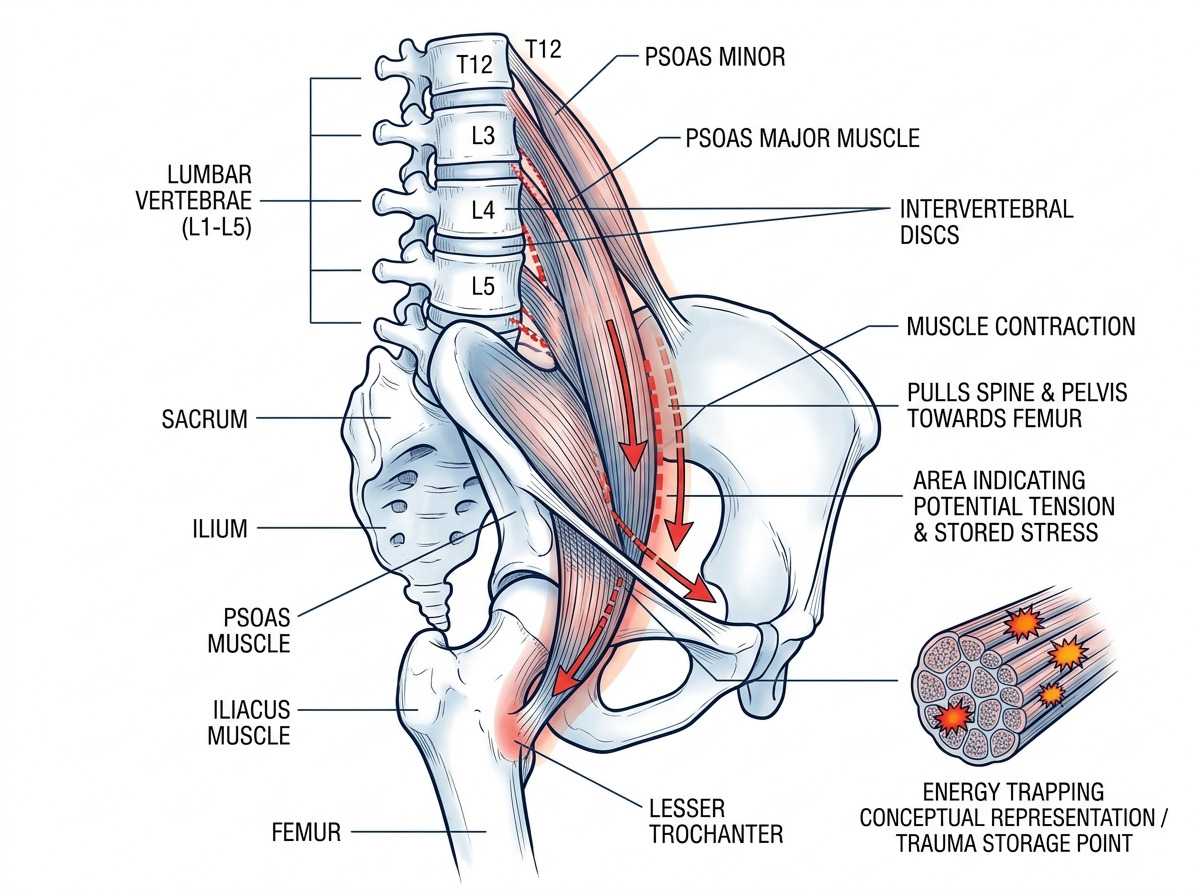
One of the primary places this stress resides is the psoas muscle. Located deep within the hip joint, the psoas is the primary "fight-or-flight" muscle. When we are startled or stressed, the psoas contracts to pull us into a protective fetal position. If we never "shake off" that stress, the psoas remains chronically tight, sending a constant signal to the brain that we are still in danger.
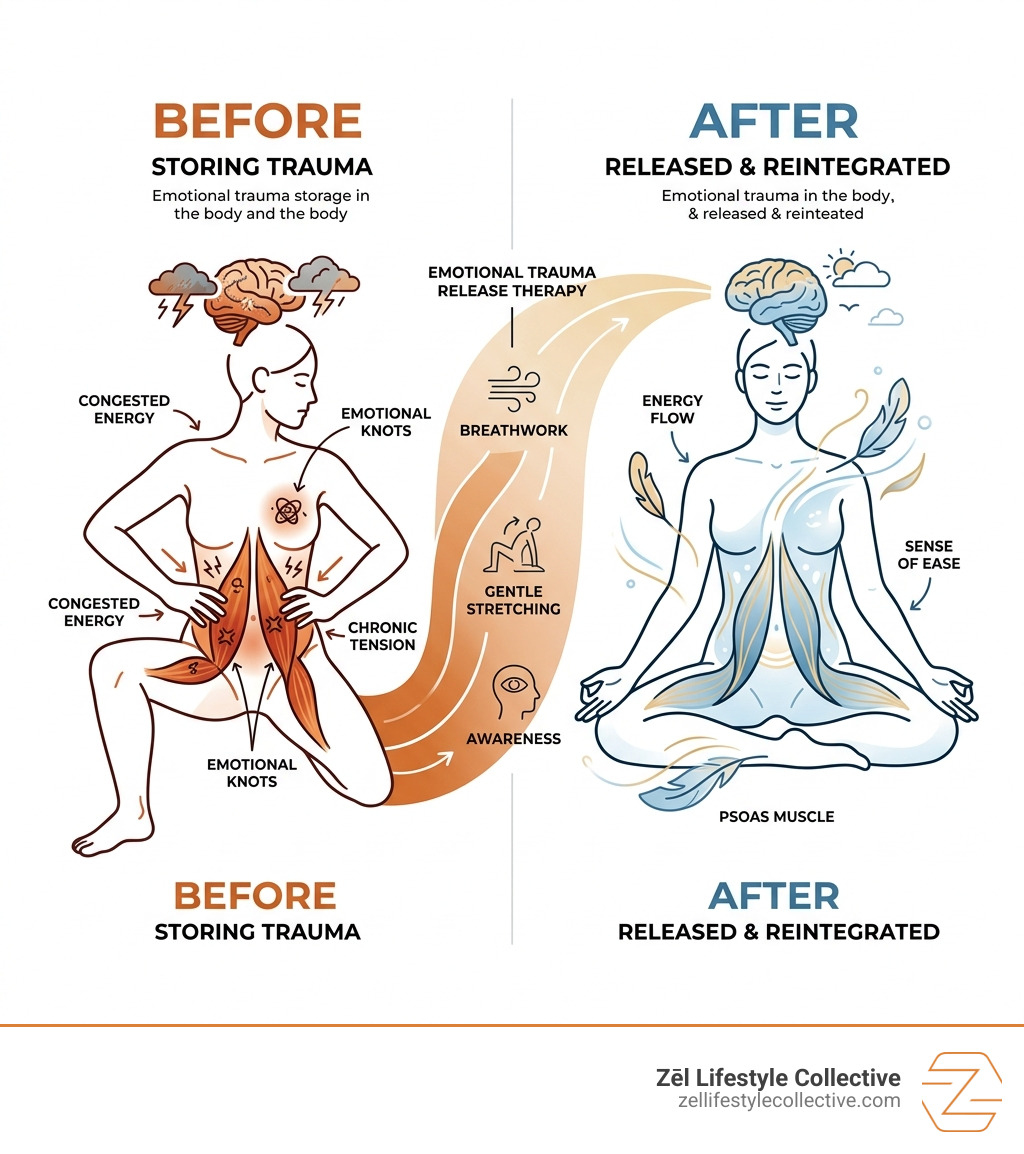
In our practice, we use Functional Medicine to look at how this chronic state of "high alert" affects your hormones, gut health, and inflammation levels. By using emotional trauma release therapy, we aim to restore the body's innate ability for self-regulation. This is heavily based on Polyvagal Theory, which explains how our vagus nerve dictates our sense of safety. Healing happens when we move out of the sympathetic (stressed) state and into the ventral vagal (safe and social) state.
How the Body Stores Trauma: Signs and Symptoms
How do you know if your body is "holding" onto something? It usually doesn't announce itself with a clear label. Instead, it shows up as "body armor"—a term coined by Wilhelm Reich to describe the chronic muscular tension we develop to wall ourselves off from painful emotions.
Common signs that your body is storing trauma include:
Muscle Armoring: Chronic tightness in the neck, shoulders, and jaw (TMJ).
Chronic Pain: Back pain or headaches that don't seem to have a structural cause or don't respond to traditional treatments.
Hypervigilance: Feeling constantly "on edge," easily startled, or having difficulty relaxing even in safe environments.
Digestive Issues: The gut is often called the "second brain," and it is highly sensitive to nervous system dysregulation.
Fatigue: Carrying around years of suppressed emotion is exhausting. You might feel "tired but wired."
Shallow Breathing: Trauma often leads to "chest breathing," where we lose the ability to take deep, diaphragmatic breaths.
Statistics from the National Institute of Mental Health estimate that about 6.8% of U.S. adults will experience PTSD at some point in their lives. However, many more suffer from "unresolved stress" that manifests physically. If you find yourself constantly clenching your jaw or noticing your breath is always shallow, your body might be trying to tell you something. This is where Massage Therapy can be a helpful entry point, as it begins to soften the physical "armor" so the emotional release can happen.
Core Techniques Used in Emotional Trauma Release Therapy
The beauty of emotional trauma release therapy is that it provides a toolkit for the nervous system. Unlike traditional methods that might dive straight into the "story" of the trauma, these techniques focus on the sensation of the trauma.

Breathwork and Body Scanning
We often start with body scanning, which is the practice of slowly bringing awareness to different parts of the body to notice where tension is held without judgment. This is paired with breathwork, specifically techniques that emphasize a long exhale to activate the parasympathetic nervous system.
Titration and Pendulation
These are the "safety valves" of somatic work. Titration involves experiencing the trauma in tiny, manageable drops so the nervous system isn't overwhelmed. Pendulation is the process of swinging your attention between a place of "tension" in the body and a place of "resource" or calm. This teaches your brain that it can move in and out of stress without getting stuck.
Resourcing and BrainTap
Resourcing is identifying internal or external things that make you feel safe—a memory, a person, or even the feeling of your feet on the floor. At Zēl, we also utilize BrainTap, which uses light and sound frequency to help guide the brain into deep states of relaxation, making it easier for the body to let go of stored stress patterns.
Body-Based Approaches and Self-Regulation
One of the most fascinating aspects of this work is the natural shaking reflex. Have you ever noticed an animal shake after a stressful encounter? Humans have that same reflex, but we often suppress it because it looks "weird." Tension and Trauma Releasing Exercises (TRE) involve a specific set of movements designed to activate these "neurogenic tremors." This allows the psoas muscle to finally release its grip.
Another powerful tool we use is the Neuro-Emotional Technique (NET). This is a mind-body approach that helps find and "fix" neurological imbalances related to the physiology of unresolved stress. It’s a fast way to identify where an emotional "loop" is stuck in the body and clear it.
Who Can Benefit from Emotional Trauma Release Therapy?
While often associated with PTSD survivors and veterans, this therapy is incredibly effective for:
High-Stress Professionals: Those who live in a state of constant "doing" and have forgotten how to "be."
Anxiety Relief: People who feel like their anxiety is a physical "hum" in their body.
Chronic Pain Patients: When physical therapy or surgery hasn't provided full relief.
Emotional Numbness: Those who feel "checked out" or disconnected from their feelings.
Interestingly, many people find that combining these releases with other holistic treatments yields the best results. For instance, understanding How Does Acupuncture Work and Who Can Benefit reveals that acupuncture also works on the nervous system to move "stuck" energy, making it a perfect companion to emotional release work.
What to Expect: Physical and Emotional Signs of Trauma Release
Releasing trauma isn't always a "Hollywood moment" where you have a massive crying fit (though that can happen!). Often, the signs are much more subtle and physiological.
During or after a session of emotional trauma release therapy, you might experience:
Muscle Twitching or Shaking: This is the nervous system discharging energy.
Tingling or Temperature Changes: Feeling sudden warmth or "pins and needles" as blood flow returns to previously constricted areas.
Yawning or Sighing: These are classic signs that the nervous system is shifting from "high alert" to "rest and digest."
Stomach Gurgling: As the body relaxes, the digestive system (which shuts down during stress) "wakes up."
Emotional Catharsis: Sudden waves of crying, laughter, or even anger that seem to come out of nowhere.
Vivid Dreams: As the brain reprocesses old information, your dreams may become more intense for a few nights.
Feeling Lighter: Many clients describe a literal sensation of a weight being lifted off their chest or shoulders.
Because these releases can be physically taxing, you might feel a temporary fatigue. This is why we often recommend Stress Management Coaching to help you integrate these changes into your daily life and ensure you are supporting your body through the healing process.
Comparing Somatic Release to Traditional Talk Therapy
It’s important to understand that emotional trauma release therapy (often called somatic therapy) isn't "better" than talk therapy like Cognitive Behavioral Therapy (CBT)—it just works on a different level.
Feature Somatic / Trauma Release Therapy Traditional Talk Therapy (CBT) Approach Bottom-Up (Body to Mind) Top-Down (Mind to Body) Primary Focus Physical sensations, nervous system Thoughts, beliefs, behaviors Mechanism Releasing stored energy/tension Changing cognitive patterns Verbal Needs Minimal; you don't have to "tell the story" High; relies on verbal processing Goal Nervous system stabilization Cognitive insight and coping skills
Talk therapy is excellent for gaining insight and changing your narrative. However, if your nervous system is "stuck" in a trauma response, your logical brain (the prefrontal cortex) actually goes offline. You can't "reason" your way out of a physiological state. Somatic therapy stabilizes the nervous system first, which actually makes talk therapy more effective later on. This follows the Adaptive Information Processing model, which suggests that once the physical "blockage" is removed, the brain can naturally process the memory.
Safe Practices and Finding a Qualified Therapist
Because emotional trauma release therapy deals with deep-seated stress, it is vital to work with a practitioner who is trauma-informed. This means they understand the pacing required to prevent "re-traumatization."
When looking for a therapist, ask about their certifications in modalities like Somatic Experiencing (SE), EMDR, or TRE. A strong therapeutic alliance—feeling safe and seen by your provider—is the single greatest predictor of success. In our Tallmadge clinic, we prioritize this safety, ensuring that every session is paced to your specific needs.
Self-Help Exercises for Home
While deep trauma should be processed with a professional, there are "vagus nerve resets" you can do at home to help manage daily anxiety:
Vagus Nerve Reset: While keeping your head straight, shift your eyes as far right as possible for 30–60 seconds until you feel a need to swallow, yawn, or sigh. Repeat on the left.
Diaphragmatic Breathing: Place one hand on your belly. Inhale slowly through your nose, making your hand move out, then exhale through pursed lips for a count of six.
Grounding: Use the 5-4-3-2-1 technique (notice 5 things you see, 4 you can touch, 3 you hear, 2 you smell, and 1 you can taste).
Somatic Tracking: When you feel a "tightness" in your body, instead of trying to make it go away, just observe it. What is its shape? Is it heavy or light? Does it have a temperature? Often, simply witnessing the sensation allows it to shift.
These practices are often taught as part of our Stress Management Coaching to give you tools for the "in-between" moments of life.
Precautions and Professional Guidance
A word of caution: if you have a history of severe complex trauma or dissociative disorders, do not attempt deep trauma release exercises alone. There is a risk of emotional overwhelm or "flooding," where the release happens too fast for your system to handle. Pacing and safety planning with a professional ensure that you stay within your "window of tolerance"—the zone where you can process emotions without shutting down or panicking.
Frequently Asked Questions
How long does it take to release trauma from the body?
There is no "magic number" of sessions. Some people feel a significant shift after just one session of EMDR or NET, while others with complex, lifelong trauma may work through layers over several months. Think of it like peeling an onion; we work through the outer layers of daily stress to get to the core patterns.
Is emotional trauma release therapy safe for everyone?
Generally, yes, but it should be modified for certain populations. For example, those with severe physical injuries may need to adapt movement-based exercises. Those with severe psychiatric conditions should always have clearance from their primary mental health provider.
Can I practice trauma release exercises without a therapist?
Simple grounding and breathing exercises are safe for almost everyone. However, for exercises that induce tremors (like TRE) or involve reprocessing traumatic memories, we highly recommend starting with a guide to ensure you know how to "ground" yourself if the experience becomes too intense.
Conclusion: A Path to Lasting Calm
At Zēl Lifestyle Collective in Tallmadge, Ohio, we believe that you cannot achieve peak performance or true health if your body is still fighting a war from ten years ago. We don't just want to mask your anxiety; we want to help you release the root cause.
By integrating emotional trauma release therapy with our other services—like Neuro-Emotional Technique (NET), chiropractic care, and functional medicine—we provide a truly holistic path to recovery. Your body has an incredible, innate ability to heal itself. Sometimes, it just needs the right environment and the right techniques to finally let go of the past.
If you’re ready to stop "managing" your anxiety and start releasing it, we’re here to help you navigate that journey. Healing isn't just about feeling better; it's about feeling whole again.