
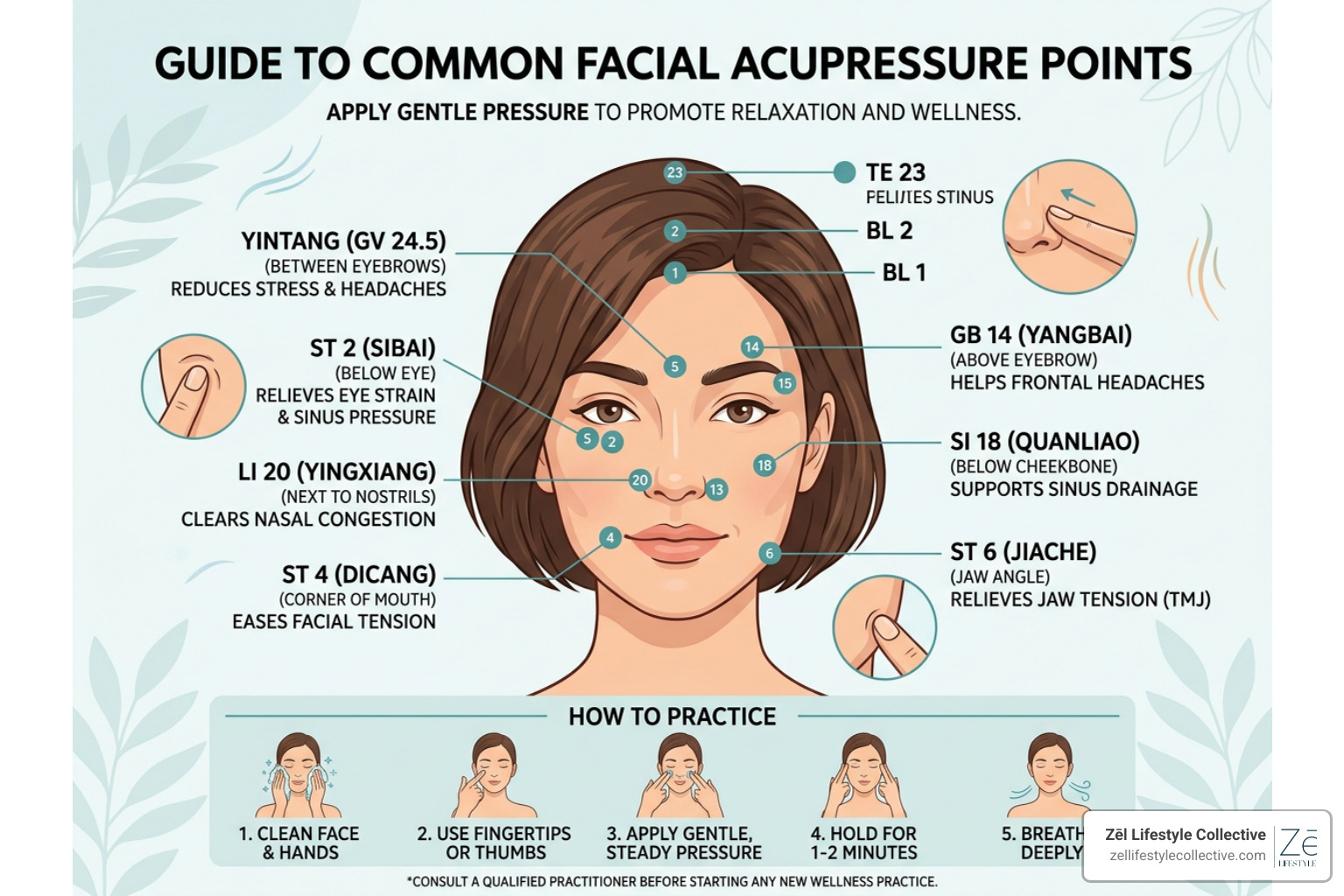
Your Complete Map to Facial Acupressure Points
What a Facial Acupressure Points Chart Actually Shows You
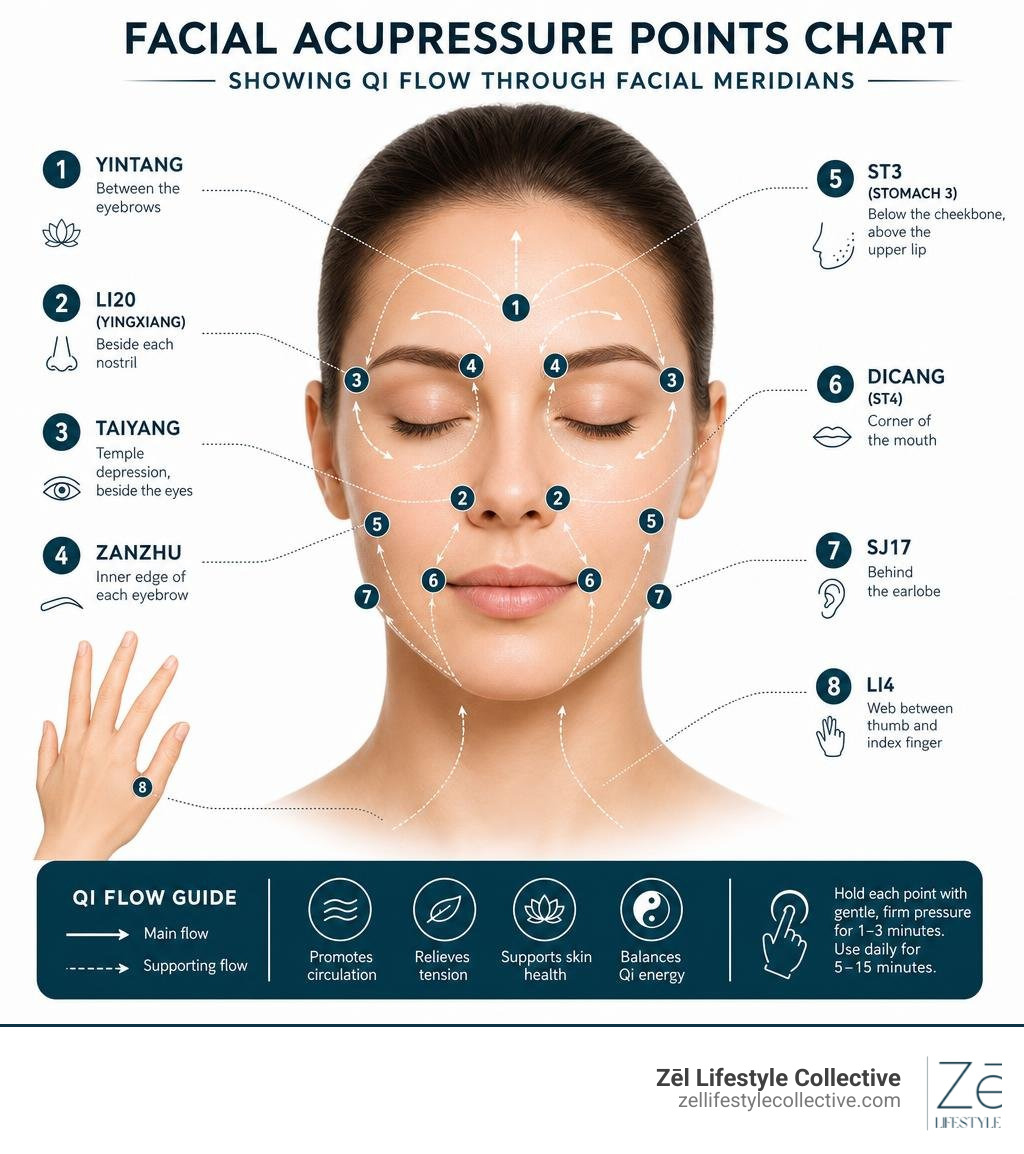
A facial acupressure points chart is a visual map of specific pressure points on the face — rooted in Traditional Chinese Medicine (TCM) — that you can stimulate with your fingertips to support circulation, ease tension, and promote skin health.
Here are the key points most charts include and what they're used for:
Point Name Location Primary Benefit Yintang Between the eyebrows Calms anxiety, eases headaches, softens frown lines LI20 (Yingxiang) Beside each nostril Clears nasal congestion, supports sinus health Taiyang Temple depression, beside the eyes Relieves one-sided headaches, eye strain Zanzhu Inner edge of each eyebrow Reduces eye fatigue, frontal headaches ST3 (Stomach 3) Below the cheekbone, above the upper lip Reduces puffiness, supports cheek tone Dicang (ST4) Corner of the mouth Lifts mouth corners, balances facial muscles SJ17 Behind the earlobe Relieves jaw tension, tinnitus, TMJ discomfort LI4 Web between thumb and index finger Reduces facial pain, stress, and congestion
Quick answer: Hold each point with gentle, firm fingertip pressure for 1–3 minutes, massaging in small circular motions. Aim for daily practice of 5–15 minutes for cumulative benefits.
Your face holds more than expression. It holds tension, stress, and a surprising number of pathways that connect to your overall health. If you've been dealing with chronic headaches, jaw tightness, sinus pressure, or skin that looks tired no matter how much sleep you get, there's a good chance your face is carrying more than you realize.
Facial acupressure has been practiced for thousands of years — and modern research is beginning to back up what TCM practitioners have long observed. A 2018 study by Hayashi et al. found that a five-minute facial massage raised cheek blood flow by roughly 25% for at least 10 minutes. That's a physiological response — not just a fleeting wellness trend.
I'm Dr. Serif Krkic, chiropractor and co-founder of Zēl Lifestyle Collective, and my background in functional medicine and regenerative health has given me a deep appreciation for how a facial acupressure points chart can serve as a practical, zero-cost tool within a broader longevity and wellness strategy. In the sections ahead, I'll walk you through exactly how to read and use one.
What is Facial Acupressure?
To understand facial acupressure, we have to look at the foundations of Traditional Chinese Medicine (TCM). TCM is built on the concept of Qi (pronounced "chee"), which is the vital life force or energy that flows through our bodies. This energy travels along specific pathways called meridians. When Qi flows smoothly, we experience health, vitality, and balanced skin. When it becomes blocked or stagnant, we often experience pain, tension, dullness, or physical symptoms like headaches and sinus congestion.
Acupressure is essentially acupuncture without the needles. Instead of using sterile, ultra-thin needles to stimulate these meridian points, we use the firm, focused pressure of our own fingers. It is a non-invasive wellness practice and a self-healing modality that anyone can learn.
When you look at a facial acupressure points chart, you are looking at anatomical areas where meridians run close to the surface of the skin, often in natural "gaps" or depressions between facial bones, muscles, and ligaments. By engaging these points, we can stimulate the nervous system, release tight fascia, and encourage the flow of both Qi and physical blood.
If you want to understand the foundational philosophy behind how these pathways work and how they influence the entire body, you can read our deep dive on How Does Acupuncture Work and Who Can Benefit. For a broader medical context on how modern science views these meridians, you can also explore the clinical perspective on Pressure Points On and For the Face.
Acupressure vs. Cosmetic Acupuncture
While both practices utilize the same meridian system and target similar points on the face, they serve slightly different purposes in your wellness and skincare routine.
Facial Acupressure (The Daily Maintenance): This is your daily, needle-free stimulation. It is entirely self-administered, costs nothing, and takes only a few minutes. It is incredible for daily stress reduction, lymphatic drainage, releasing chronic jaw tension, and giving your skin an immediate, healthy flush of oxygenated blood.
Cosmetic Acupuncture (The Deep Restoration): This is a professional treatment performed in a clinical setting. During a session, a licensed acupuncturist inserts hair-thin, sterile needles into specific points on the face and body. This does something finger pressure alone cannot: it creates controlled microscopic "micro-injuries" in the dermis. This triggers your body's natural healing cascade, directly boosting collagen and elastin production to soften deep lines, lift sagging tissue, and improve skin elasticity from the inside out.
At our clinic in Tallmadge, Ohio, we often recommend combining the two. You can use daily acupressure at home to maintain your results, while scheduling regular professional sessions for deeper, structural skin rejuvenation. To see how these professional treatments fit into your budget and what to expect, check out our guide on Facial Acupuncture Cost, and learn more about the treatment itself on our dedicated Cosmetic Acupuncture page.
The Complete Facial Acupressure Points Chart
When you first look at a facial acupressure points chart, it might look like a complex map of anatomical landmarks. Don't let the technical terms intimidate you. In clinical TCM, points are often located using a measurement unit called a cun (or tsun), which is relative to your own body. For example, 1 cun is roughly equal to the width of your thumb at the knuckle.
By using these physical landmarks — like the corner of your eye, the edge of your nostril, or the dip in your temple — you can easily find these points on your own face.
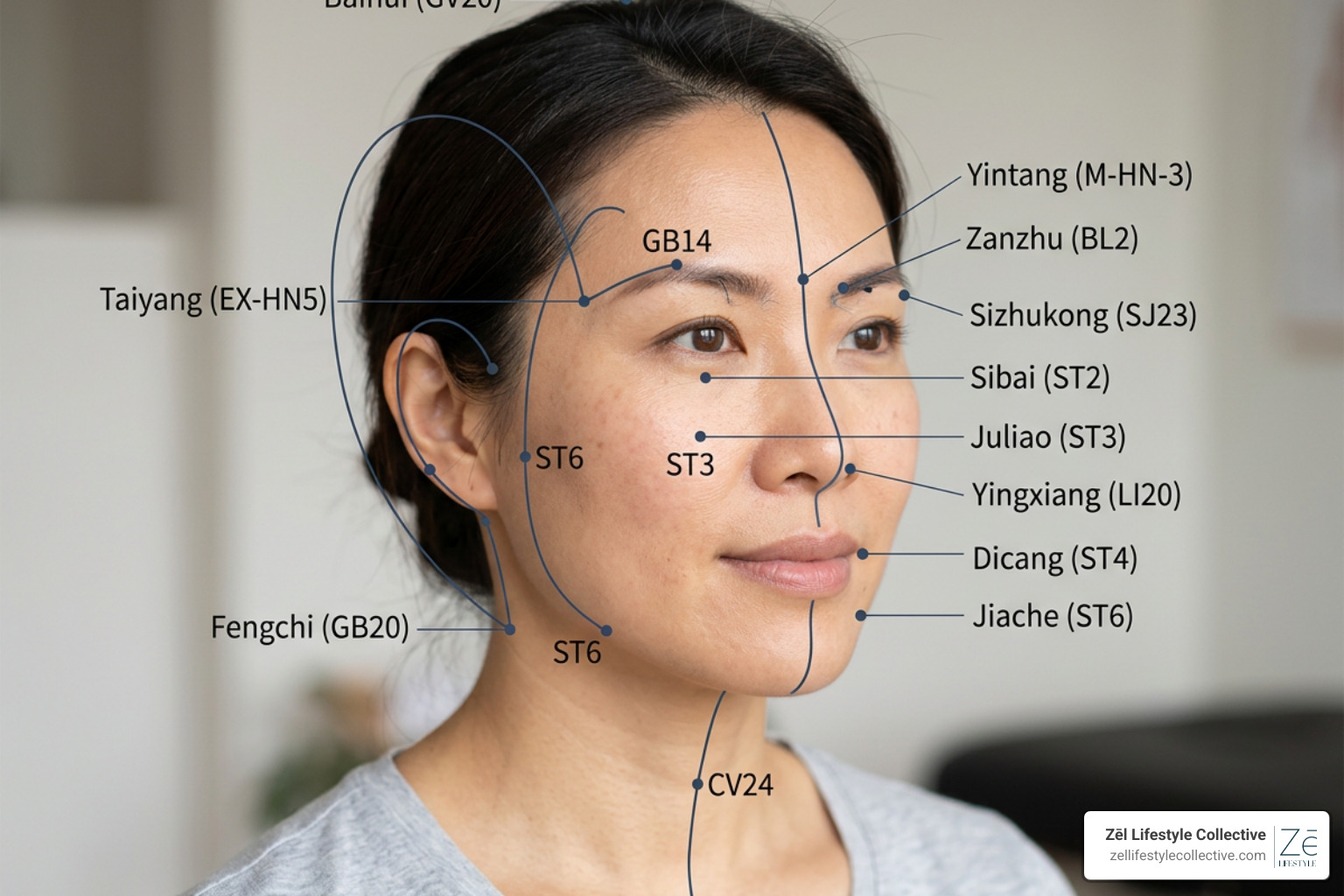
To help you get started with a physical reference you can print out or keep on your phone, you can download a Free Facial Acupressure Chart - PDF.
Forehead and Brow Points on the Facial Acupressure Points Chart
Let's break down the most powerful points on the upper third of your face. These points are highly effective for relieving mental fatigue, frontal headaches, and softening the tension lines that form when we concentrate or squint.
Yintang (The "Third Eye" Point): Located directly between your eyebrows, right above the bridge of your nose. This is one of the most famous calming points in TCM. Pressing here helps quiet an overactive mind, eases frontal sinus pressure, and relaxes the corrugator muscles (which cause those vertical "11" frown lines).
Zanzhu (Bladder 2): Located at the inner edge of each eyebrow, in the small hollows where the brow bone meets the bridge of the nose. This point is a savior for eye strain, dry eyes, and headaches caused by staring at screens all day in our modern digital world.
Yuyao (Extra Point): Located in the exact center of your eyebrow, directly above the pupil when you are looking straight ahead. It is highly effective for relieving tension around the eyes, reducing upper eyelid puffiness, and lifting the brow line.
Gallbladder 14 (GB14): Located about 1 cun (one thumb-width) directly above the center of your eyebrow, aligned with the pupil. Stimulating this point helps tone the frontalis muscle of the forehead, helping to soften horizontal forehead wrinkles while relieving frontal headaches.
Gallbladder 15 (GB15): Located just inside the hairline, directly above GB14 and the pupil. This is a key point for calming the nervous system, relieving insomnia, and clearing mental fog.
For a deeper look at how these upper-face points are mapped out anatomically, you can reference the Acupressure Facial Points Chart.
Eye, Cheek, and Jaw Points on the Facial Acupressure Points Chart
Moving down the face, these points target the cheeks, sinuses, mouth, and jawline. They are highly beneficial for promoting a lifted, sculpted appearance, clearing nasal passages, and releasing deep jaw tension (TMJ).
Taiyang (The Temple Point): Located in the soft depression of your temples, about one finger-width behind the midpoint between the outer end of your eyebrow and the outer corner of your eye. Pressing here is incredibly soothing for one-sided headaches, migraines, and mental exhaustion.
Bitong (Extra Point): Located at the very top of the nasolabial groove, right where the nostril meets the nose bridge. This is the ultimate "emergency" point for immediate sinus relief and clearing stubborn nasal congestion.
Yingxiang (Large Intestine 20 / LI20): Located in the nasolabial groove, directly level with the lower border of the nostril. Stimulating this point opens up the nasal passages, relieves allergic rhinitis, and boosts circulation to the center of the face.
Dicang (Stomach 4 / ST4): Located at the corners of the mouth, directly lateral to the corner of the lips. This point helps lift the corners of the mouth, improves smile symmetry, and tones the muscles around the lips to soften marionette lines.
Daying (Stomach 5 / ST5): Located on the lower jawbone, in the groove just anterior to the masseter muscle. Pressing here boosts local blood flow, helps define the jawline, and reduces facial fatigue.
Stomach 7 (Xiaguan): Located in the depression anterior to the ear joint (temporomandibular joint), below the zygomatic arch. When you open your mouth, this depression fills in. This is the premier point for anyone who clenches their jaw, grinds their teeth at night, or suffers from TMJ pain.
To explore how these points are utilized to restore facial symmetry and tone, you can review the Acupressure Facial Rejuvenation Points Chart.
Benefits of Stimulating Facial Acupressure Points
Stimulating these points does more than just move energy; it triggers measurable physical changes in your skin and underlying tissues. When you apply firm pressure to these points, you are actively encouraging:
Enhanced Blood Circulation: This brings a rush of fresh oxygen and nutrients to the skin's surface, resulting in an immediate, healthy glow.
Lymphatic Drainage: The face can easily hold stagnant lymphatic fluid, which shows up as morning puffiness, particularly around the eyes. Acupressure helps move this fluid toward the lymph nodes in the neck, naturally sculpting and depuffing your features.
Myofascial Release: Our facial muscles grip tension just like our shoulders do. Chronic tension in the brow or jaw can restrict blood flow and lead to premature aging. Acupressure coaxes these tight muscles to relax.
Nervous System Regulation: The face is highly innervated. Stimulating these points activates the parasympathetic ("rest and digest") nervous system, lowering cortisol levels and reducing systemic stress.
To see how these physical mechanisms can be elevated to stimulate deeper structural change, read our article on Cosmetic Acupuncture Collagen Boost. You can also review the clinical workshop notes on Facial Accupressure Massage for a deeper scientific perspective on these benefits.
Skin Rejuvenation and Anti-Aging
If you're looking to support your skin as you age gracefully, facial acupressure is a fantastic, non-invasive tool to add to your vanity. While it won't instantly freeze your muscles like Botox, it works with your body's natural physiology to produce gradual, cumulative improvements.
Soften Fine Lines: By relaxing hyperactive muscles (like the ones that cause frown lines or forehead furrows), you prevent those lines from etching deeper into the skin.
Boost Elasticity: Improved blood flow means better delivery of the building blocks your skin needs to maintain its structure.
Reduce Under-Eye Bags: Stimulating points around the orbital bone (like Zanzhu and Yuyao) gently drains stagnant fluid that pools under the eyes.
Define the Jawline: Working points along the jaw and masseter muscle helps release tension that can pull the lower face downward, supporting a firmer, more lifted jawline.
Relief from Headaches, Sinus Congestion, and Tension
Facial acupressure is just as much about how you feel as how you look. It is an incredibly effective, drug-free way to manage everyday physical ailments.
Sinus Pressure: Points like LI20 (Yingxiang) and Bitong act like a natural decongestant, helping to drain the sinuses during allergy season or a cold.
Tension Headaches: Pressing Yintang and Taiyang can quickly take the edge off a throbbing forehead or temple headache.
TMJ and Jaw Pain: Massaging Stomach 7 and the jawline points releases the masseter muscle, which is often the main culprit behind jaw clicking, teeth grinding, and tension headaches.
How to Safely Perform Facial Acupressure at Home
Ready to try it yourself? Before you begin, a little preparation goes a long way.
Wash Your Hands and Face: You'll be touching your face repeatedly, so start with clean hands and a freshly cleansed face to avoid pushing dirt or bacteria into your pores.
Apply a Light Facial Oil or Serum: While you can perform acupressure on dry skin, a few drops of oil or serum provide "slip." This prevents your fingers from dragging or pulling on the delicate skin of your face.
Find a Comfortable Position: Sit in a relaxed chair in front of a mirror so you can easily locate the points. Relax your neck, drop your shoulders, and take a few deep, cleansing breaths.
Apply the Right Pressure: Use the pads of your index or middle fingers (or your thumbs for jaw points). Apply pressure that is firm but comfortable. It should feel like a deep, satisfying ache — never sharp pain. If you feel bruising or discomfort, lighten your touch.
To help you understand how facial acupressure fits in with other popular facial rejuvenation methods, here is a quick comparison:
Technique Primary Mechanism Best For Skill Level Required Facial Acupressure Static, firm pressure on specific meridian points Releasing deep tension, sinus relief, nervous system calming Beginner (easy to learn) Gua Sha Scraping the skin with a flat stone tool Deep lymphatic drainage, lifting, and sculpting facial contours Intermediate (requires proper tool angles) Face Yoga Active muscle exercises and resistance training Building muscle volume to plump hollow areas Advanced (requires consistency and correct form)
Step-by-Step Daily Routine
Here is a simple, 5-minute routine you can easily fit into your morning or evening skincare ritual:

Awaken the Mind (Yintang): Place your middle finger between your eyebrows. Press firmly and massage in slow, clockwise circles for 30 seconds while breathing deeply.
Lift the Brows (Zanzhu & Yuyao): Using your index fingers, press the inner corners of your eyebrows (Zanzhu). Hold for 10 seconds. Slide your fingers to the center of your brows (Yuyao) and hold for another 10 seconds.
Soothe the Temples (Taiyang): Place your index and middle fingers on your temples. Apply gentle, firm pressure and massage in slow circular motions for 30 seconds to release mental tension.
Clear the Sinuses (LI20): Press firmly on either side of your nostrils. Hold for 30 seconds, breathing through your mouth if your nose is congested.
Sculpt the Cheeks (ST3): Locate the point directly below your pupils, just under your cheekbones. Press upward and inward gently for 20 seconds to drain puffiness.
Release the Jaw (Stomach 7): Place your fingers on the joint just in front of your ears. Open and close your mouth slightly to feel the muscle move, then apply firm pressure and massage in circular motions for 45 seconds to melt away jaw clenching.
The Drainage Sweep: Finish by gently sweeping your fingers from the center of your face outward toward your ears, and then down the sides of your neck to flush out drained lymphatic fluid.
To see how this daily routine can complement professional holistic therapies, check out our Ultimate Guide to Cosmetic Acupuncture 2026.
Precautions and Contraindications
While facial acupressure is incredibly safe for most people, there are a few times when you should skip it or modify your approach:
Active Breakouts and Open Wounds: Never press directly on active acne, open cuts, cold sores, or severely inflamed rosacea. Doing so can spread bacteria or worsen inflammation. Work around these areas instead.
Recent Injectables: If you have recently received Botox or dermal fillers, avoid performing acupressure on your face for at least two weeks to prevent shifting the product.
Bruising and Fragile Skin: If you bruise easily or have extremely thin, fragile skin, keep your pressure very light.
Pregnancy: While facial acupressure is generally safe during pregnancy, keep your pressure light and avoid stimulating heavy systemic points on the body (like LI4 on the hand) without consulting your prenatal care provider first.
Frequently Asked Questions about Facial Acupressure
How often should I perform facial acupressure to see results?
For the best results, consistency is key. We recommend practicing for 5 to 10 minutes daily. Just like going to the gym, the benefits are cumulative. You will notice an immediate, radiant flush right after your session, but lasting improvements in skin tone, muscle relaxation, and reduced puffiness typically take 3 to 4 weeks of regular practice to become noticeable.
Can facial acupressure help with acne or rosacea?
While acupressure can support skin health by boosting circulation and aiding lymphatic drainage (which helps flush out cellular waste), it is not a cure for chronic skin conditions like acne or rosacea. In fact, pressing directly on inflamed breakouts can irritate the skin further. Use acupressure as a supportive, relaxation-focused tool, but always consult a professional for targeted medical treatments.
Do I need special tools to perform facial acupressure?
Not at all! Your own fingertips are the absolute best tools for the job — they are free, always with you, and allow you to feel the exact amount of pressure you are applying. However, if you want to elevate your routine, you can use a smooth jade or rose quartz roller, or integrate high-quality essential oils tailored to your skin type (such as lavender for sensitive skin or tea tree for oilier complexions) during your massage.
Conclusion
Your face is a beautiful reflection of your internal health. By utilizing a facial acupressure points chart and spending just a few minutes a day connecting with these meridian points, you can release stored tension, support your skin's natural vitality, and bring a sense of calm to your entire nervous system.
At Zēl Lifestyle Collective in Tallmadge, Ohio, we believe in personalized, holistic, root-cause treatments that support your body's innate ability to heal. Whether you are looking to combine your at-home acupressure routine with professional Cosmetic Acupuncture, chiropractic care, massage, or clinical functional medicine, we are here to support you on your wellness journey.
Ready to experience a deeper reset than fingertips alone can provide? Reach out to us today to schedule a personalized consultation, and let's build a holistic routine that leaves you feeling vibrant from the inside out.