
More Than Just a Pill: Understanding Nutraceuticals and Supplements
More Than a Buzzword: What Nutraceuticals and Supplements Actually Are
Nutraceuticals and supplements are two of the most talked-about terms in health and wellness — and also two of the most misunderstood.
Here's the quick answer:
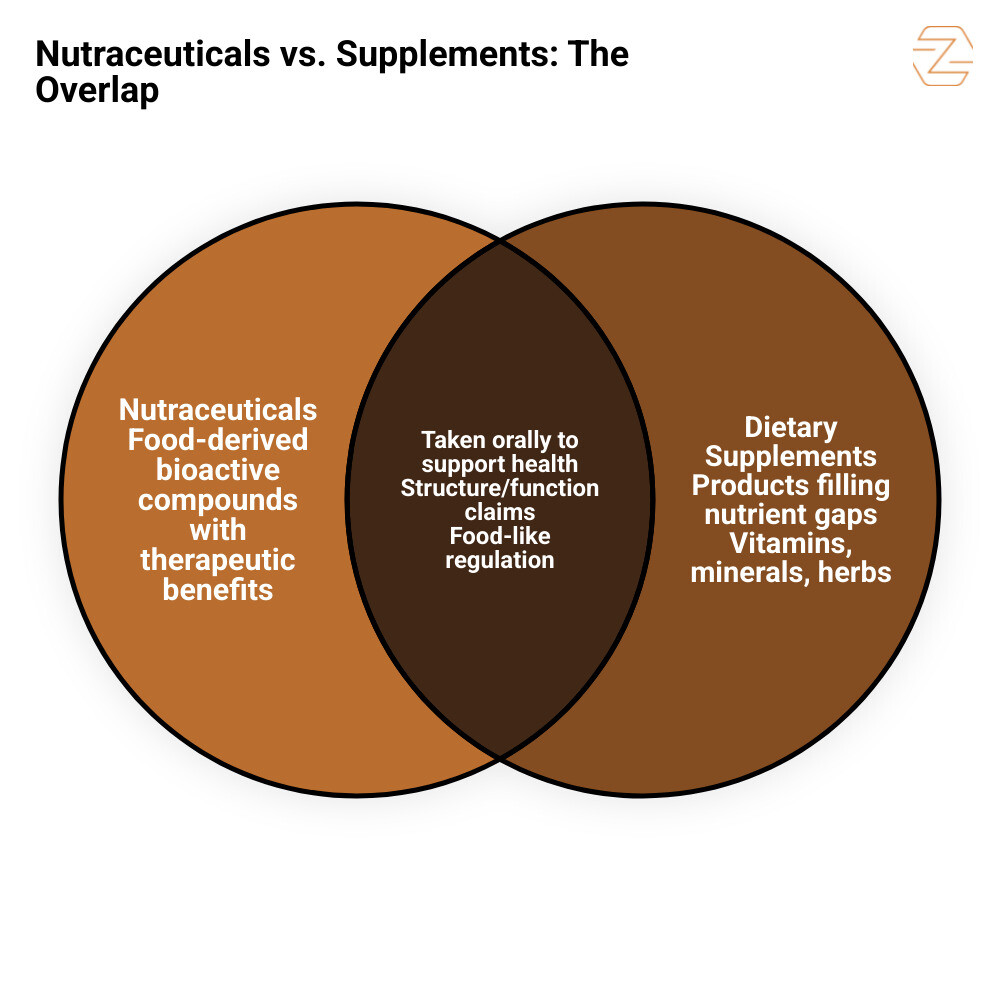
Nutraceuticals Dietary Supplements Definition Food-derived compounds with therapeutic or disease-prevention benefits beyond basic nutrition Products taken by mouth to fill nutritional gaps in the diet Examples Curcumin, omega-3 fatty acids, plant sterols, probiotics Vitamin D, calcium, iron, multivitamins Claims allowed Can imply targeted health benefits; more medicinal edge Structure/function claims only — cannot claim to treat or cure disease Regulation No standardized global definition; varies by country Regulated as food under DSHEA (1994) in the U.S. Primary purpose Prevent or manage specific health conditions Compensate for nutrient deficiencies
The term nutraceutical was coined in 1989 by Dr. Stephen DeFelice. He blended "nutrition" and "pharmaceutical" to describe bioactive food compounds that do more than just nourish — they actively support health outcomes.
Think of it as a spectrum. On one end, you have whole foods. On the other, pharmaceutical drugs. Nutraceuticals sit in between — natural in origin, but with measurable, evidence-backed effects on the body.
The confusion between the two is understandable. Labels are often vague, marketing claims can be bold, and regulation hasn't kept pace with the industry's rapid growth.
I'm Dr. Serif Krkic, a chiropractor and functional medicine practitioner at Zēl Lifestyle Collective, and I've spent years helping high-performing individuals cut through the noise around nutraceuticals and supplements to build truly personalized, science-backed health strategies. In this guide, I'll walk you through everything you need to know — from definitions and evidence to safety concerns and what actually works.
Defining Nutraceuticals and Supplements
When we talk about nutraceuticals and supplements, we are navigating a complex landscape of definitions. In the United States, the legal backbone for this industry is the Dietary Supplement Health and Education Act (DSHEA) of 1994. Under this law, a dietary supplement is defined as a product taken by mouth that contains a "dietary ingredient"—such as vitamins, minerals, herbs, or amino acids—intended to supplement the diet.
However, the term "nutraceutical" is a bit more of a hybrid. While it isn't an official FDA category, it is widely used in clinical and scientific circles to describe products that offer a "medicinal edge." These are often isolated nutrients or herbal products that have demonstrated efficacy in managing or preventing specific pathological conditions.
Category Definition Key Characteristic Dietary Supplements Products intended to augment the diet (vitamins, minerals, etc.) Regulated as food; covers nutrient gaps Functional Foods Conventional foods fortified with bioactive ingredients (e.g., Vitamin D milk) Eaten as part of a regular diet Nutraceuticals Isolated compounds with pharmaceutical-grade health benefits Focus on therapeutic outcomes and disease prevention
For a deeper dive into how these categories are categorized scientifically, you can explore Nutraceuticals and food supplements: basic concepts.
The Core Differences in Nutraceuticals and Supplements
The primary distinction lies in the intent and the evidence. Dietary supplements are generally used to prevent deficiencies—like taking Vitamin C to ensure you don't fall short of your daily requirement. Nutraceuticals, on the other hand, are often used to address a specific health challenge or "pathological" state.
For example, while a multivitamin "supports overall health" (a structure-function claim), a nutraceutical like plant sterols is specifically studied for its ability to lower LDL cholesterol. At Zēl Lifestyle Collective, we use these distinctions to tailor our Functional Medicine protocols. We don't just want to fill gaps; we want to use these bioactive tools to shift your physiology toward healing.
Common Sources and Classifications
Nutraceuticals are classified based on their chemical nature and their food source. We can break them down into several key groups:
Probiotics and Prebiotics: Live beneficial bacteria (probiotics) and the fibers that feed them (prebiotics), essential for gut health and immune function.
Polyunsaturated Fatty Acids (PUFAs): Most notably Omega-3s found in fish oil and algae.
Phytochemicals: Plant-based compounds like curcumin (from turmeric), epigallocatechin gallate (EGCG from green tea), and genistein (from soy).
Dietary Fiber: Soluble and insoluble fibers that regulate digestion and blood sugar.
Herbal Extracts: Concentrated forms of plants like Ginkgo biloba or St. John’s Wort.
Vitamins and Minerals: When used in therapeutic doses to treat specific conditions (like high-dose Vitamin D for autoimmune support).
Therapeutic Applications and Health Benefits
The reason the global market for nutraceuticals and supplements is exploding is simple: they work. Research has shown that these compounds can have a profound impact on chronic disease management.

Take cardiovascular health, for instance. Heart disease accounts for roughly 30% of global annual deaths. Clinical trials have shown that fish oil supplements can reduce the mortality rate by 29% in men who have previously suffered a heart attack. Furthermore, regular consumption of fish oil has been linked to a 45% reduction in sudden cardiac deaths.
Similarly, plant sterols and stanols are heavy hitters for cholesterol management. Studies indicate that taking 2–3 grams per day can reduce LDL ("bad") cholesterol by up to 15-20%. This level of efficacy bridges the gap between simple "nutrition" and pharmaceutical intervention. For more evidence-based insights, see this Nutraceutical, Nutrition Supplements and Health Benefits: A Review.
Cancer Support and Chronic Disease Management
One of the most exciting frontiers for nutraceuticals and supplements is oncology support. While they are not "cures," bioactive compounds can modulate inflammation and support the body's antioxidant defenses.
Curcumin: Found in turmeric, it is widely studied for its anti-inflammatory and anti-cancer properties.
Genistein: A high concentration of this soy-derived isoflavone has been linked to a staggering 69% reduction in the risk of prostate cancer in certain populations.
Ginger: Often used to manage chemotherapy-induced nausea and systemic inflammation.
In our practice, we often see that Autoimmune Symptoms Are Not Random. They are frequently driven by underlying inflammation that targeted nutraceuticals can help modulate.
Specialized Nutraceuticals and Supplements for Longevity
As we age, our nutritional needs change, and the "wear and tear" on our cells increases. Specialized compounds like silibinin (from milk thistle) support liver health, while wheatgrass and aloe vera have been shown to assist in skin recovery and radiation-induced dermatitis.
Longevity isn't just about living longer; it's about maintaining cognitive function and bone health. Nutraceuticals like Vitamin K2 and Vitamin D3 are essential for keeping calcium in the bones and out of the arteries. To understand the biological drivers of aging, check out our guide on Why Do We Age and How Can We Slow It Down?.
Formulation Challenges and Safety Concerns
While the benefits are vast, the "pill" itself is a feat of engineering. Creating effective nutraceuticals and supplements isn't as simple as grinding up a plant and putting it in a capsule.
One of the biggest hurdles is bioavailability. Many of the most powerful compounds, like curcumin, have "poor solubility." This means your body struggles to absorb them before they are flushed out of your system. To overcome this, innovative manufacturers use:
Nanoemulsions: Breaking particles down to a microscopic scale for better absorption.
Liposomes: Wrapping the nutrient in a fat bubble that mimics our cell membranes.
Phytosomes: Complexing herbal extracts with phospholipids.
Chemical instability is another issue. Many vitamins and oils are sensitive to heat, light, and oxygen. If a supplement isn't formulated correctly, it may be "dead on arrival" by the time it reaches your shelf in Tallmadge.
Quality Control and Adulteration Risks
Because the FDA regulates supplements as food, they don't vet them for safety or efficacy before they hit the market. This creates a "wild west" scenario where adulteration is surprisingly common.
In one alarming study, 74 out of 91 herbal items tested for sexual enhancement actually contained undeclared PDE-5 inhibitors (the active ingredient in Viagra). Other studies have found that 3 out of 5 soy-based supplements failed to contain the amount of isoflavones claimed on the label. Heavy metal contamination (lead, mercury, arsenic) and microbial purity are also significant concerns in low-quality brands. For a deeper look at these risks, read Nutraceuticals: a promising, yet unregulated Frontier in Healthcare.
Potential Drug Interactions
"Natural" does not always mean "safe" when combined with conventional medicine. Nutraceuticals and supplements can have potent biological effects that interfere with prescription drugs.
Garlic and Warfarin: Garlic has natural blood-thinning properties. Taking it with a prescription blood thinner like Warfarin can dangerously increase bleeding risks.
St. John’s Wort: This herb is notorious for activating the cytochrome P450 enzyme system in the liver. This can cause the body to process other medications (like birth control or heart meds) too quickly, rendering them ineffective.
Ginger: Can also interact with anticoagulants.
This is why we emphasize the importance of professional guidance, especially when dealing with The Truth About Hormone Optimization. You need a provider who understands how your "natural" stack interacts with your medical history.
Global Market Trends and Regulatory Landscape
The nutraceutical industry is a global powerhouse. The market is projected to reach approximately $340 billion by 2024, growing at a steady CAGR of 7.2%. Interestingly, over 90% of the market is concentrated in Europe, the USA, and Japan.
However, the supply chain is highly centralized. Approximately 75–80% of the raw materials used in these products worldwide are sourced from China. This creates a vulnerability in the market, as seen during global supply chain disruptions. Meanwhile, regions like India are seeing explosive growth (21% CAGR), aiming to become major players in the production of herbal and botanical extracts.
Navigating the Future of Nutraceuticals and Supplements
The future of health is personalized. We are moving away from "one size fits all" multivitamins toward nutrigenomics—using your DNA to determine exactly which nutraceuticals and supplements your body requires.
Technological advancements are also changing how we take these nutrients. Fast-dissolving films and advanced IV Therapy allow for 100% absorption by bypassing the digestive tract entirely. This is particularly useful for those with malabsorption issues or chronic fatigue.
Regulatory Oversight and Classification Hurdles
The lack of a standardized global definition for "nutraceuticals" remains a major hurdle. In Japan, the "FOSHU" (Foods for Specified Health Uses) system provides a rigorous pathway for functional foods. In the U.S., the FDA's role is largely post-market. They can only step in to pull a product after it has been proven unsafe or if the manufacturer makes illegal "drug claims" (like saying a supplement "cures cancer").
For consumers, this means the burden of quality control often falls on the manufacturer's willingness to follow Good Manufacturing Practices (GMP). Always look for third-party testing seals (like NSF or USP) to ensure what is on the label is actually in the bottle.
Frequently Asked Questions about Nutraceuticals
What is the main difference between a nutraceutical and a dietary supplement?
A dietary supplement is intended to "supplement" the diet and fill nutrient gaps (like a multivitamin). A nutraceutical is a food-derived compound used with a medicinal intent to provide health benefits, including the prevention or treatment of disease, often backed by more specific clinical evidence.
Are nutraceuticals safer than traditional pharmaceutical drugs?
Generally, nutraceuticals have a lower risk of severe adverse effects than pharmaceuticals because they are derived from food sources. However, they are not risk-free. They can be potent, cause side effects, and interact dangerously with prescription medications. "Natural" is not a synonym for "harmless."
How can I tell if a nutraceutical label is accurate?
Because of the lack of pre-market FDA approval, you should look for "GMP Certified" facilities and third-party testing. Avoid products that make "miracle" claims or use vague "proprietary blends" that don't list the exact dosage of each active ingredient.
Conclusion
At Zēl Lifestyle Collective in Tallmadge, Ohio, we believe that health isn't found in a single pill, but in a holistic, root-cause approach. Nutraceuticals and supplements are powerful tools in our kit, but they work best when integrated into a personalized plan that includes functional medicine, proper nutrition, and lifestyle adjustments.
Whether you are looking to manage a chronic condition, optimize your athletic performance, or simply age with grace, understanding the science behind what you put in your body is the first step. Don't leave your health to chance or marketing hype.
Start your journey with professional Nutraceuticals and let us help you build a strategy that is as unique as your DNA.