
How to Build a Weight Loss Plan That Actually Sticks in Ohio
Why Most Weight Loss Plans Fail — And What Actually Works
A sustainable weight loss plan is the difference between results that last and results that disappear after a few weeks. If you're short on time, here's what the evidence says works:
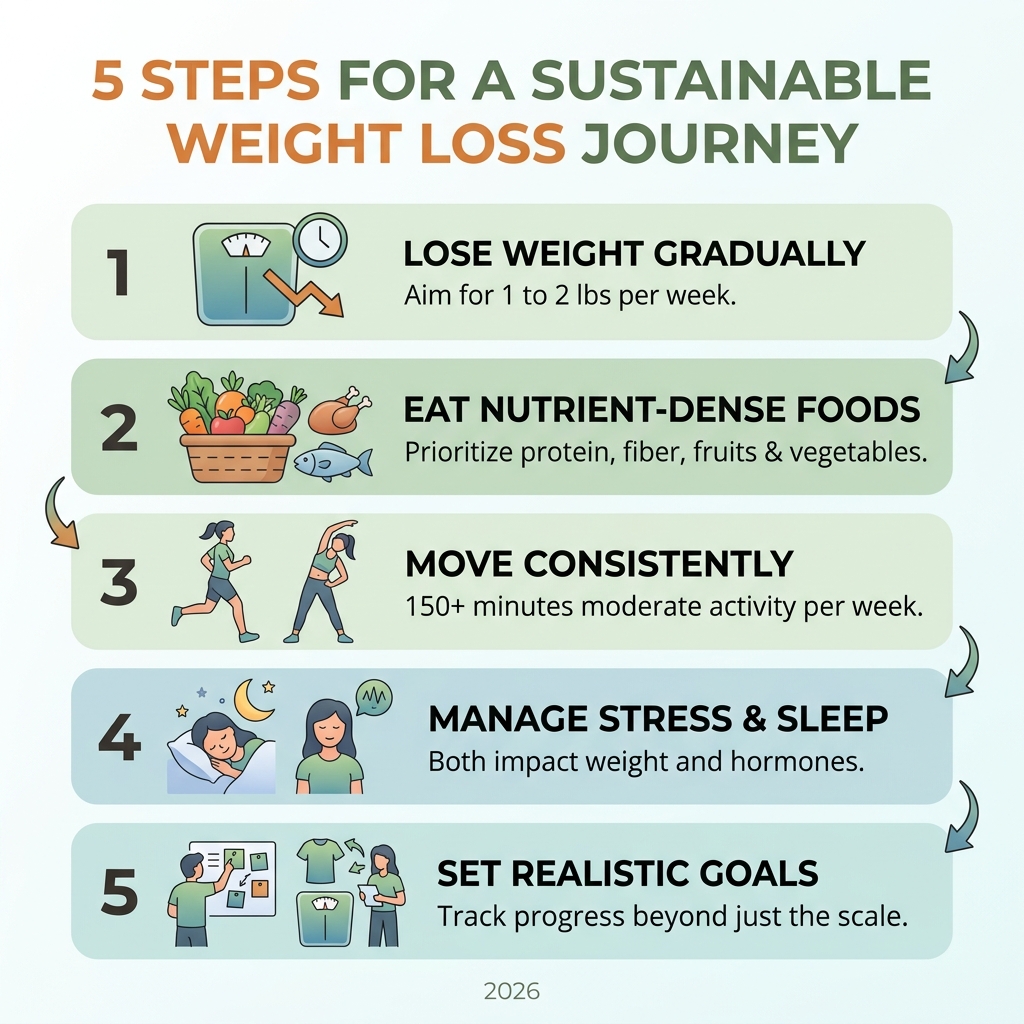
The core elements of a sustainable weight loss plan:
Lose weight gradually — aim for 1 to 2 pounds per week
Eat whole, nutrient-dense foods — prioritize protein, fiber, fruits, and vegetables
Move consistently — at least 150 minutes of moderate activity per week
Manage stress and sleep — both directly impact weight and hormones
Set realistic goals — track progress beyond just the scale
Build a support system — professional guidance accelerates lasting results
You've probably tried a plan before. Maybe it worked for a month. Then life got busy, stress crept in, and the weight came back.
That's not a willpower problem. It's a plan design problem.
Most weight loss approaches focus on short-term restriction — cutting carbs, slashing calories, doing intense workouts. They create results fast, but they're nearly impossible to maintain. Research consistently shows that the vast majority of people who lose weight rapidly regain it within a year.
The hard truth? Quick fixes don't fix anything.
For busy professionals in their 40s especially, weight management gets more complicated. Hormones shift. Stress piles up. Sleep suffers. And the conflicting advice online makes it even harder to know where to start.
The good news: modest changes made consistently do work. Even losing just 5% of your body weight — that's 10 pounds for a 200-pound person — can meaningfully improve blood pressure, cholesterol, and blood sugar levels, reducing your risk of heart disease and type 2 diabetes.
I'm Dr. Serif Krkic, chiropractor, functional medicine practitioner, and co-founder of Zēl Lifestyle Collective in Tallmadge, Ohio — and building a sustainable weight loss plan grounded in root-cause health strategies is at the core of what I do. In this guide, I'll walk you through exactly how to build one that fits your life and actually sticks.
What Defines a Sustainable Weight Loss Plan?
When we talk about a sustainable weight loss plan, we aren't talking about a "diet" with a start and end date. We are talking about a permanent shift in how you live. Sustainability is defined by your ability to maintain the habits for years, not just weeks.
According to Steps for Losing Weight | CDC, people who lose weight at a gradual, steady pace—about 1 to 2 pounds a week—are significantly more likely to keep the weight off than those who drop it rapidly. This slow-and-steady approach allows your metabolism to adjust and prevents the extreme hunger cues that often lead to "yo-yo" dieting.
But why is this so crucial for long-term health? It’s about more than just fitting into old jeans. Even a modest weight loss of 5% (for example, 10 pounds for a 200-pound person) can drastically improve:
Blood Pressure: Reducing the strain on your heart.
Cholesterol Levels: Improving the balance of "good" and "bad" fats in your blood.
Blood Sugar: Lowering the risk of prediabetes and type 2 diabetes.
As we age, this becomes even more vital. We often see patients who wonder Why Weight Loss Gets Harder After 40. Factors like muscle loss (sarcopenia), hormonal shifts (like declining estrogen or testosterone), and increased stress play a massive role. A sustainable plan accounts for these biological shifts rather than fighting against them.
Core Components of a Long-Term Lifestyle
A truly sustainable weight loss plan looks beyond the treadmill and the salad bowl. It integrates several pillars of health that work synergistically. If you only focus on calories, you’re missing the bigger picture of how your body actually functions.

The core components include:
Nutrient Density: Choosing foods that provide the most "bang for your calorie buck."
Volume Eating: Using high-fiber foods to stay full.
Hydration: Ensuring your thirst isn't being mistaken for hunger.
Movement: Integrating activity into your daily life, not just the gym.
Mindset: Shifting from "restriction" to "nourishment."
As noted in Weight loss: 6 strategies for success, success is rarely about one single change; it’s about a comprehensive lifestyle overhaul that feels manageable and even enjoyable.
Building a Sustainable Weight Loss Plan Through Nutrition
Nutrition is the foundation. However, instead of focusing on what to remove, we encourage our Tallmadge patients to focus on what to add.
High-Protein Diets: Protein is the most satiating macronutrient. It helps preserve lean muscle mass while you lose fat, which is essential for keeping your metabolism high. Aiming for 1.0 to 1.2 grams of protein per kilogram of ideal body weight is often a great starting point for weight maintenance.
Fiber-Rich Vegetables: Fiber adds bulk to your meals, triggering "fullness" signals in the brain via stomach expansion. This is often called "volume eating." You can eat a massive bowl of roasted vegetables for a fraction of the calories found in a small bag of chips.
Mediterranean Eating: This isn't a strict diet but a pattern. It emphasizes fruits, vegetables, whole grains, lean proteins, and healthy fats like olive oil. Research, including the DIETFITS study, shows that focusing on high-quality whole foods—regardless of whether you prefer low-carb or low-fat—leads to successful weight loss.
To see how this works in practice, check out our guide on how to Elevate Your Fitness Journey with 5 Proper Meals.
The Role of Physical Activity and Movement
While you can't "out-run a bad diet," physical activity is the "secret sauce" for weight loss maintenance. It helps regulate your appetite, improves mood, and keeps your cardiovascular system resilient.
The Eating & Physical Activity to Lose or Maintain Weight - NIDDK guidelines suggest:
Aerobic Activity: At least 150 minutes of moderate-intensity activity (like brisk walking) per week. To prevent weight regain, this may need to increase toward 300 minutes.
Muscle Strengthening: At least twice a week. Muscle is metabolically active tissue; the more you have, the more calories you burn at rest.
HIIT (High-Intensity Interval Training): Incorporating 1-2 sessions of HIIT can boost cardiovascular health and burn calories efficiently in a short window.
If the gym feels boring, don't force it. We love seeing our Ohio community get creative. Try some 5 Innovative Physical Exercise Ideas to Try to keep things fresh.
Psychological Factors: Stress, Sleep, and Behavioral Change
This is where most plans fall short. You can have the perfect meal plan, but if you're chronically stressed and sleeping four hours a night, your body will fight weight loss every step of the way.
Cortisol and Stress: High stress levels trigger cortisol, a hormone that encourages the body to store fat, particularly around the midsection. Stress also leads to emotional eating—using food as a tool to soothe the nervous system.
Sleep and Circadian Rhythm: Lack of sleep disrupts the hormones ghrelin (which makes you hungry) and leptin (which tells you you're full). When you're tired, you crave sugar and quick energy. Setting a regular bedtime and avoiding screens 30 minutes before sleep are essential steps in any sustainable weight loss plan.
Habit Stacking: Instead of trying to change everything at once, "stack" a new habit onto an old one. For example, "After I pour my morning coffee, I will drink one full glass of water."
Improving your psychological resilience makes the physical work much easier. For more on this connection, read our Nutrition Tips to Enhance Your Physical Exercise.
Setting Realistic Goals and Tracking Progress
Vague goals like "I want to lose weight" rarely lead to action. To build a plan that sticks, you need to get specific. We recommend the SMART framework: Specific, Measurable, Achievable, Relevant, and Time-bound.
But there’s a nuance here: differentiate between Outcome Goals and Action Goals.
Outcome Goal: "I want to lose 10 pounds in two months." (You don't have total control over this).
Action Goal: "I will walk for 30 minutes, five days a week." (You have total control over this).
Focusing on action goals builds "self-efficacy"—the belief that you can actually do what you set out to do. As you achieve these small wins, your motivation grows.
Tracking is also vital. Whether it’s a nutrition diary, a fitness app, or a simple notebook, seeing your progress on paper helps you identify patterns. Maybe you notice you always overeat on Thursdays—why? Is it a stressful meeting? Identifying these triggers is the first step to fixing them. As highlighted in How to Build a Sustainable Weight Loss Routine, tracking non-scale victories is just as important as the number on the scale.
Creating Your Sustainable Weight Loss Plan Roadmap
A roadmap helps you navigate the inevitable bumps in the road. Acknowledge now that setbacks will happen. You'll go to a family BBQ in Tallmadge and eat more than planned. That’s okay. The key to a sustainable weight loss plan is how quickly you get back on track.
Short-Term Milestones: Celebrate losing the first 5 pounds or completing a full week of workouts. Non-Scale Victories (NSVs): These are often more motivating than the scale. Are your clothes fitting better? Do you have more energy to play with your kids? Is your brain fog lifting?
Fueling your body correctly for these milestones is key. Learn What to Eat Before a Workout: Fuel Up for Your Best Performance to make sure you have the energy to reach your goals.
Finding Support and Professional Guidance in Ohio
You don't have to do this alone. In fact, research shows that people with a support system are far more successful at long-term weight management. Support can take many forms:
Friends and Family: Letting them know your goals so they can encourage you (and maybe stop bringing doughnuts over).
Community Groups: Walking clubs or local fitness classes in Tallmadge.
Professional Guidance: This is where we come in.
At Zēl Lifestyle Collective, we don't believe in "one-size-fits-all" dieting. We offer personalized, holistic programs like Thrive6 and Vitality 360 that look at your unique biology. We use functional medicine to identify root causes—like gut health issues, hormonal imbalances, or nutrient deficiencies—that might be stalling your progress.
Our clinic in Tallmadge, Ohio, provides a range of supportive therapies, including:
IV Therapy: To replenish essential vitamins and minerals.
Chiropractic Care & Massage: To keep your body moving pain-free.
Acupuncture: To help manage stress and cravings.
Functional Medicine: To get to the "why" behind your weight.
Frequently Asked Questions about Weight Loss
What are the health benefits of even modest weight loss?
As we've mentioned, even a 5% reduction in body weight can significantly improve your health markers. For a 200-pound person, that’s just 10 pounds. This "modest" loss can lower blood pressure, improve cholesterol, and stabilize blood sugar. It's often enough to move someone out of the "prediabetic" range and reduce the need for certain medications.
What considerations or potential risks should I be aware of before starting?
Before starting any new sustainable weight loss plan, it’s essential to consult with a healthcare professional, especially if you have underlying conditions like heart disease, kidney issues, or diabetes. Rapid weight loss can sometimes lead to gallstones or nutrient deficiencies. Additionally, if you have a history of disordered eating, a focus on strict tracking might not be the healthiest approach for you. We always recommend a "health-first" perspective.
How can I maintain my weight loss after reaching my goal?
Maintenance is the hardest part. The key is to keep doing exactly what you did to lose the weight, but with slightly more flexibility. Continue tracking your weight occasionally to catch any "upward drift" early. Keep your physical activity levels high—aiming for 300 minutes of movement per week is a gold standard for maintenance. Most importantly, stay connected to your "why."
Conclusion
Building a sustainable weight loss plan isn't about perfection; it's about persistence. It’s about choosing whole foods because they make you feel vibrant, moving your body because it makes you strong, and managing your stress because you deserve peace.
At Zēl Lifestyle Collective, we are proud to serve the Tallmadge and greater Ohio community with root-cause, integrative treatments. We believe that weight loss is just one part of a larger journey toward vitality. Whether you need the structural support of chiropractic care or the metabolic insights of functional medicine, we are here to help you build a plan that actually sticks.
Ready to stop the cycle of dieting and start living? Start your journey with a sustainable weight loss plan and discover what your body is truly capable of.