
Acupuncture for Pain Relief and How it Works for You
Understanding Acupuncture for Back Pain
Back pain acupuncture relief is real, and the science backs it up. Here's the short answer if you need it fast:
Does acupuncture help back pain? Yes. Multiple large studies show acupuncture reduces pain intensity, improves physical function, and outperforms no treatment or usual care alone.
How quickly does it work? Most people see meaningful improvement within 6–12 sessions over a few weeks.
How long do results last? Research shows benefits can persist for 12 months or longer.
Is it safe? Yes. Side effects are minor (mild soreness, occasional bruising) and serious adverse events are extremely rare.
Who is it for? Anyone with chronic or acute low back pain, including older adults, people with sciatica, herniated discs, or sacroiliac joint issues.
Nearly 8 in 10 people will experience lower back pain at some point in their lives. For many, it becomes a chronic condition that disrupts work, sleep, and everyday movement. Standard treatments — pain medications, rest, even surgery — often fall short, leaving people searching for something that actually works long-term.
Acupuncture, rooted in Traditional Chinese Medicine and now backed by modern clinical research, has emerged as one of the most evidence-supported non-drug options for back pain. A 2025 NIH-funded trial of 800 adults aged 65 and older found that acupuncture significantly reduced pain disability and improved physical function at both 6- and 12-month follow-ups — outperforming usual medical care alone.
I'm Dr. Serif Krkic, chiropractor and co-founder of Zēl Lifestyle Collective, and I've spent my career helping patients find lasting relief through integrative, root-cause approaches — including back pain acupuncture relief as part of a personalized care plan. In this guide, I'll walk you through exactly how acupuncture works, what the research says, and how to get started.
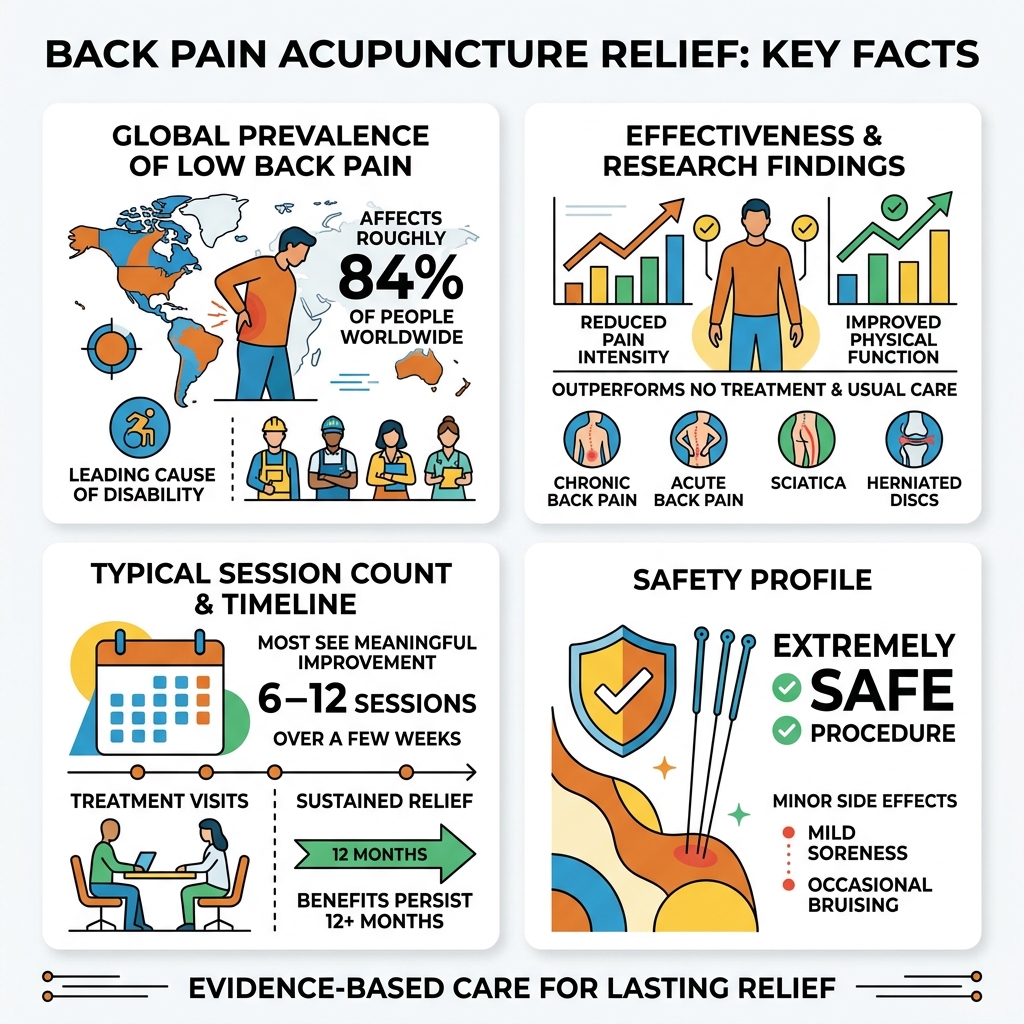
At Zēl Lifestyle Collective in Tallmadge, Ohio, we see the global burden of low back pain every day. Statistics show that low back pain affects roughly 84% of the world's population at some point. It isn't just a minor ache; it is the leading cause of disability worldwide, costing the U.S. economy over $100 billion annually in medical expenses and lost productivity.
Traditional Chinese Medicine (TCM) views this pain through the lens of "Qi" (pronounced chee), or vital energy. When Qi becomes stagnant or blocked along "meridian pathways"—the invisible channels through which energy flows—pain and dysfunction arise. By inserting hair-thin needles into specific points along these meridians, we aim to restore the balance of energy, effectively "unblocking" the system to allow the body to heal itself. While this sounds mystical to some, modern Western science has spent decades filming and measuring exactly what happens in the body during this process, confirming that these ancient "points" correspond to significant clusters of nerves and connective tissue.
How Back Pain Acupuncture Relief Works in the Body
When we talk about back pain acupuncture relief, we aren't just talking about a "feel-good" placebo effect. There is a complex biological cascade that occurs the moment a needle is inserted. Acupuncture primarily communicates with your central nervous system—the brain and spinal cord.
One of the most well-documented effects is the immediate release of endorphins. These are your body's natural painkillers, chemically similar to opioids but without the risk of addiction or side effects. Furthermore, acupuncture helps with serotonin regulation, which is why so many of our patients at Zēl Lifestyle Collective report feeling significantly more relaxed or even falling asleep during their sessions.
We often get asked, How Does Acupuncture Work and Who Can Benefit? Beyond just dulling pain, it stimulates the release of neurotransmitters that tell the brain to "turn down the volume" on pain signals. It also promotes local healing by increasing blood flow to the site of the injury and reducing systemic inflammation. At our clinic, Acupuncture is a cornerstone of our integrative approach because it addresses both the physical injury and the neurological perception of pain.
Targeted Points for Back Pain Acupuncture Relief
A common misconception is that if your lower back hurts, the needles only go in your lower back. In reality, an expert acupuncturist uses a combination of local and distal points. For lower back issues, we might use points on the:
Lower back itself: To address local muscle tension and inflammation.
Back of the knees: A powerful point for releasing the entire posterior chain of muscles.
Feet and Hands: Distal points that help regulate the flow of energy through the long meridians that run up the spine.
Hips and Stomach: To balance the core muscles that support the spine.
Research published in Acupuncture for chronic nonspecific low back pain highlights that individualized point selection—tailoring the treatment to your specific type of pain—often yields better results than a "one-size-fits-all" approach.
The Science of Neurotransmitter Regulation
The "magic" of the needle is actually neurochemistry. Acupuncture triggers the release of opioid-like hormones and other chemicals like norepinephrine and orexin. These substances work together to suppress pain signals before they even reach the brain's conscious awareness.
In some cases, we may also utilize Dry Needling, which specifically targets "trigger points" or muscle knots. While similar in appearance to acupuncture, dry needling focuses more on the mechanical release of tight muscle fibers, whereas traditional acupuncture focuses on the broader nervous system and energetic balance. Both are highly effective tools in our Tallmadge facility.
Clinical Evidence and Recent Research Studies
If you are a skeptic, the data is on your side—meaning the data proves it works. The most exciting recent development is the 2025 NIH "BackInAction" trial. This pragmatic study followed 800 adults aged 65 and older who suffered from chronic low back pain. The results were clear: those who received acupuncture showed significantly greater reductions in pain disability and higher physical function scores compared to those receiving "usual care" (standard doctor visits and medications). These benefits weren't just temporary; they were sustained at 6-month and 12-month follow-ups.
This mirrors a massive 2018 meta-analysis involving nearly 21,000 patients, which concluded that "true" acupuncture was substantially more effective than both no treatment and "sham" acupuncture (where needles are placed randomly). Another systematic review, Acupuncture vs usual care for chronic low back pain, found that the intermediate-term effects (2-6 months) were often even larger than the immediate effects, suggesting that the body continues to improve long after the needles are removed.
Comparing Acupuncture to Usual Medical Care
When we compare acupuncture to standard Western protocols, the safety profile is usually what stands out most. A study titled Acupuncture Versus Oral Medications for Acute/Subacute Non-Specific Low Back Pain found that acupuncture was not only more effective at reducing pain but also carried far fewer risks of side effects like gastrointestinal distress or dependency, which are common with NSAIDs and opioids.
Treatment Type Primary Benefit Risk Level Common Side Effects Acupuncture Nerve stimulation & natural painkiller release Very Low Minor bruising, mild soreness Oral NSAIDs Inflammation reduction Moderate Stomach upset, kidney strain Physical Therapy Functional movement & strength Low Muscle soreness Surgery Structural correction High Infection, long recovery, nerve damage
We often utilize "motion-style" acupuncture, where the patient performs gentle movements while the needles are in place. Research suggests this can be up to 12% more effective for acute lumbar sprains than medication alone.
Long-Term Results of Back Pain Acupuncture Relief
One of the most impressive statistics in our field comes from a patient-level meta-analysis of nearly 18,000 patients: 90% of the pain-relieving effects of acupuncture were sustained at 12 months. This is a game-changer for people wondering Why Do I Have Back Pain? Understanding Causes and Solutions. It suggests that acupuncture isn't just a "band-aid"; it helps recalibrate how your nervous system handles pain over the long haul. Furthermore, the NIH trial noted a significant reduction in anxiety symptoms among acupuncture patients, proving that when your physical pain decreases, your mental health often follows.
Conditions Treated and What to Expect
Acupuncture is versatile. At Zēl Lifestyle Collective, we use it to treat a wide array of spinal conditions, including:
Sciatica: Reducing nerve inflammation and shooting leg pain.
Sacroiliac (SI) Joint Dysfunction: Addressing the 15-20% of back pain cases that actually originate in the pelvis.
Herniated Discs: Relieving the pressure and muscle guarding around the spine.
Spinal Stenosis: Helping manage the chronic discomfort of a narrowing spinal canal.
We often combine these sessions with our Chiropractic Service for structural alignment or Massage Therapy to soften the surrounding tissues.
Your First Acupuncture Session
Walking into your first session can feel a bit intimidating, but we promise it’s one of the most relaxing things you’ll do all week. We start with a comprehensive initial assessment to understand your history and "root cause."
Once you are comfortable on the table, we insert between 5 and 20 hair-thin, sterile, single-use needles. You might feel a tiny "pinch" or a dull, heavy sensation known as De Qi. This is actually a good sign—it means the needle has engaged the nervous system. You will then rest for 10–30 minutes in a quiet room. Depending on your needs, we might also integrate Cupping Therapy to improve circulation or MLS Laser Therapy for deep tissue healing.
Safety, Side Effects, and Contraindications
Acupuncture is incredibly safe when performed by a licensed professional. Serious adverse events occur in fewer than 0.05 per 10,000 treatments. The most common side effects are minor: a tiny bit of bruising or a slight "achy" feeling that disappears within a day.
However, there are a few people who should take extra precautions:
Pregnancy: Certain points are "forbidden" during pregnancy as they can stimulate labor. Always tell us if you are pregnant.
Blood Thinners/Bleeding Disorders: While the needles are tiny, those on anticoagulants may bruise more easily.
Pacemakers: If we are using electroacupuncture (where a mild current is passed through the needles), we must avoid the area around a pacemaker.
Always ensure your provider is a licensed acupuncturist with NCCAOM certification, as we are at Zēl.
Frequently Asked Questions about Acupuncture
How many sessions are needed for back pain relief?
While some people feel a "miracle" after one visit, most chronic conditions require a cumulative approach. A typical course involves 6–12 sessions. We usually start with 1–2 visits per week for the first month, then gradually space them out as your pain stabilizes. Many of our Tallmadge patients choose to stay on a "maintenance" schedule of one visit per month to keep the pain from returning. You can see our full range of Services to see how we build these plans.
Is acupuncture for back pain covered by insurance?
The landscape is changing rapidly! Medicare now covers acupuncture for "chronic low back pain" (defined as lasting 12 weeks or longer, with no identifiable systemic cause). Many private insurance plans in Ohio also offer coverage. We recommend checking with your provider to see if they use specific billing codes for acupuncture.
Does acupuncture hurt?
In a word: No. Acupuncture needles are about the thickness of a human hair—much smaller than the needles used for shots or blood draws. Most people feel a slight sensation upon insertion, followed by a profound sense of relaxation. It is quite common for patients to drift off into what we call an "acu-nap."
Conclusion
At Zēl Lifestyle Collective, our mission is to move beyond the "pill for every ill" mentality. We believe in personalized, holistic, root-cause treatments that actually help you get your life back. Whether you are dealing with a fresh injury or a decade of chronic aches, back pain acupuncture relief offers a scientifically proven path toward healing without the risks of invasive surgery or addictive medications.
Located in the heart of Tallmadge, Ohio, our integrative medicine clinic is ready to help you combine the best of ancient wisdom and modern science. If you're ready to stop managing symptoms and start addressing the source of your pain, we invite you to Start your journey with Functional Medicine and our expert acupuncture team today.